How long does SEO take to work?

Most websites start seeing measurable ranking movement within 3-4 months of consistent SEO work, with meaningful traffic and lead growth typically taking 6-12 months: the exact timing depends on how competitive your target keywords are, your site's existing authority, and how much technical and content groundwork needs fixing before rankings can move at all. Anyone promising page-one rankings within days or weeks is either targeting terms with almost no competition, or doing something Google will eventually catch and reverse.
Why does SEO take so much longer than paid ads?
A paid ad buys a position the moment the auction clears. Organic rankings have to be earned: Google needs to crawl your changes, index them, and then build enough confidence in your site's authority and consistency to move a result up past competitors who've been building the same signals for longer. That confidence comes from accumulated evidence: content quality, technical health, backlinks, user engagement, not a single optimisation event, which is why SEO behaves more like compound interest than a light switch.
What's a realistic SEO timeline, month by month?
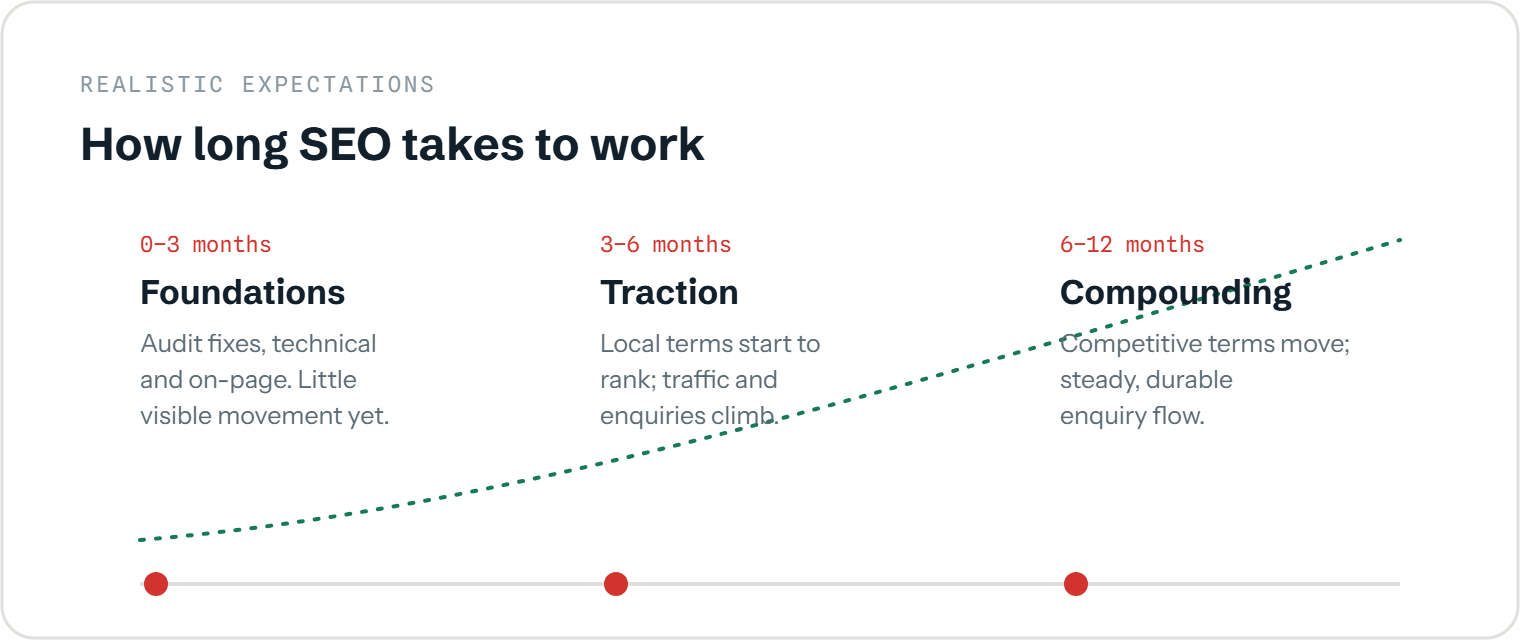
Every site is different, but the shape of the curve is consistent enough to plan around. This is the typical pattern for a small-to-medium UK business starting from a reasonably healthy website:
| Timeframe | What's typically happening | What you'll see |
|---|---|---|
| Month 1-2 | Technical fixes, keyword research, content foundations, on-page work | Little visible change — this is groundwork |
| Month 3-4 | Google re-crawls and indexes the changes; trust starts to build | First movement on lower-competition, long-tail terms |
| Month 5-6 | Content and links continue to accumulate | Organic traffic growth becomes measurable; some page-one rankings |
| Month 7-12 | Compounding effect of consistent work | Competitive terms start moving; leads/enquiries become trackable |
| 12+ months | Ongoing maintenance and refresh work | Results mature; rankings need protecting, not just chasing |
What makes SEO faster or slower for a specific business?
Five things move the timeline more than any tactic: how established the site already is (a 10-year-old domain with existing authority moves faster than a brand-new one); how competitive the target keywords and location are (a niche trade term in a small town beats "solicitor" in a city centre every time); how much technical debt has to be cleared first (broken indexing or a botched migration can add months before rankings can improve at all); how much genuinely useful content already exists versus needs building from scratch; and (the one entirely in the business owner's control) whether the work is consistent or stop-start. Restarting SEO after a six-month gap doesn't resume where it left off; some of that trust decays and has to be rebuilt.
Does local SEO move faster than national SEO?
Generally yes. As covered in our guide to local SEO, Google Business Profile changes can shift local visibility within weeks, and map-pack rankings typically build over 8-12 weeks, much faster than competing for a national organic term, which leans more heavily on domain-wide authority and backlinks that take longer to accumulate. That's one reason local SEO is often the fastest route to a measurable return for South Wales businesses serving Cardiff, Newport, Swansea or the wider region — the ranking factors (profile completeness, reviews, citation consistency) are simply quicker to influence than the depth needed to win a competitive national keyword.
How long until SEO pays for itself, not just ranks?
Rankings, traffic and revenue arrive in that order, each with its own lag. Rankings move first (months 3-6 for most businesses), traffic follows as those rankings hold and expand to more keywords, and revenue follows traffic as visitors convert at whatever rate your site and offer support. For most small businesses running a genuine, consistently-resourced campaign, a realistic point to expect SEO to be paying for itself (enquiries and sales exceeding the monthly spend) is somewhere in the 6-12 month range, with local and lower-competition niches often landing at the earlier end.
What can legitimately speed SEO up?
Fixing technical problems immediately rather than working around them, since a crawl or indexing issue caps everything else you do. Targeting realistically winnable keywords first (long-tail and lower-competition terms that can rank in months, building the authority that makes competitive terms possible later) rather than going straight for the highest-volume phrase in the market. Claiming and completing a Google Business Profile if local search matters, since it's one of the few SEO levers Google can act on quickly. And simply staying consistent: a steady drip of work compounds; bursts followed by silence don't. None of this skips the underlying trust-accumulation process — it just avoids wasting the early months on things that can't move the needle yet.
What slows SEO down, and what should you avoid?
A site migration or redesign done without proper redirects can wipe out months of accumulated rankings overnight. Thin or duplicate content dilutes rather than adds authority. Buying low-quality links is the single biggest false shortcut — it occasionally works briefly, then risks a Google penalty that sets the timeline back further than doing nothing at all would have. And the quiet killer is inconsistency: businesses that start SEO, pause it for budget reasons, then restart months later are effectively paying for the ramp-up period twice.
The flip side to all of this: SEO's slowness is also its durability. Paid ads stop the moment the budget stops; organic rankings built properly keep working with far less ongoing spend to maintain them. The time investment is the trade-off for a channel that compounds instead of switching off.
Want a realistic timeline for your own site?
A free audit shows exactly where you're starting from, and how long it would realistically take to move the needle.
Book a free audit