How to appear in Google AI Overviews

To appear in Google's AI Overviews, a page generally needs to already rank well organically, answer a specific question directly and completely in its opening lines, and carry clear structured signals (schema, headings, consistent facts) that make it easy for Google's systems to lift and cite. There's no separate "AI Overviews SEO": Google draws citations from the same crawlable, well-structured content that ranks normally, then rewards the pages that answer cleanly enough to quote.
What are AI Overviews and why do they matter now?
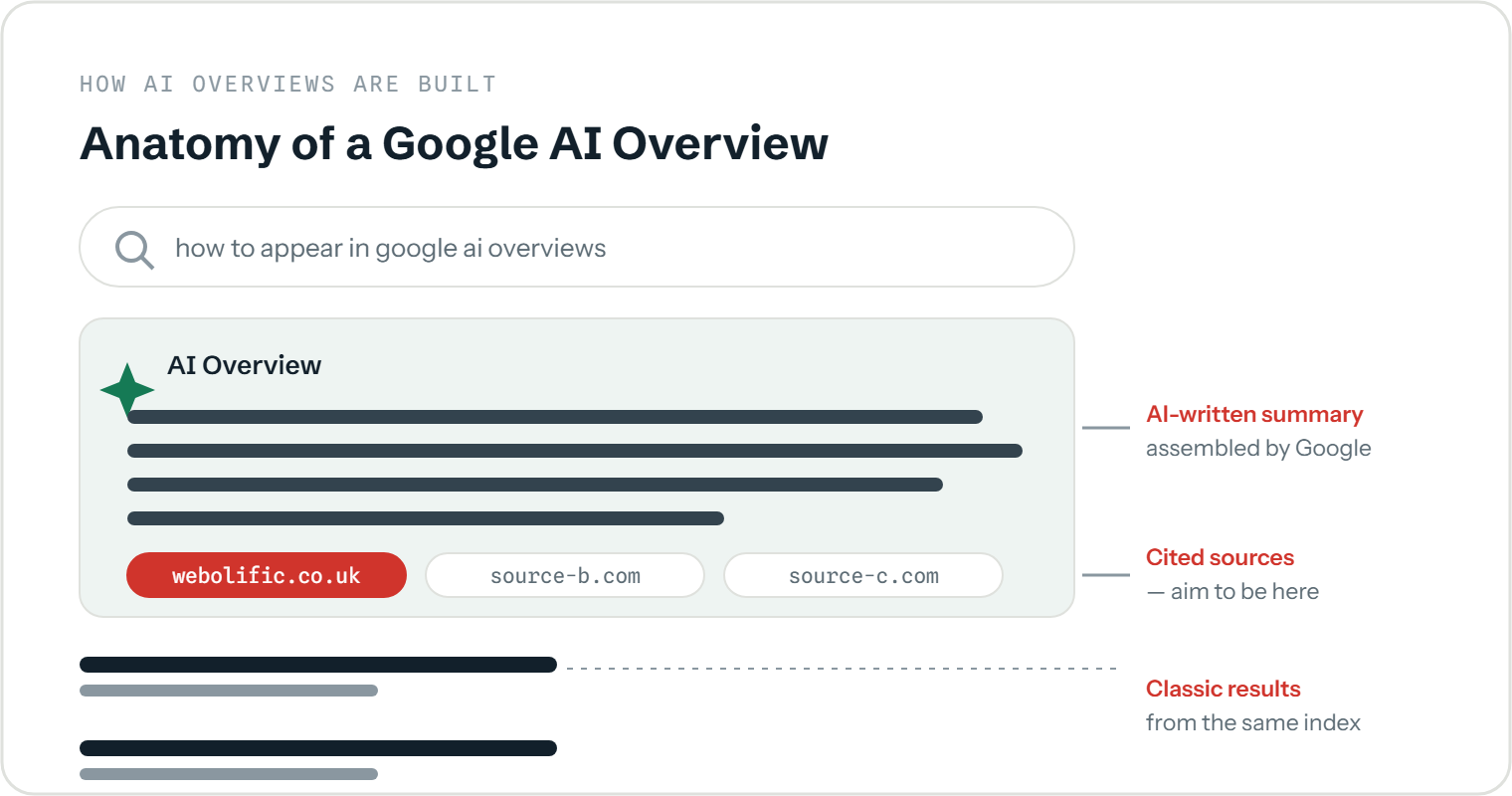
AI Overviews are the AI-generated summary Google shows above the traditional blue links for a growing share of searches, pulling together an answer from several sources and citing (some of) them. They matter because they sit above position one — a page that ranks #3 organically can still be the page AI Overviews quotes, effectively jumping the queue. And because a well-answered AI Overview can satisfy the searcher without a click, being the cited source is now worth as much as the click itself: it's brand exposure even when it doesn't drive traffic.
How does Google choose which pages to cite?
Google isn't inventing a new ranking system for this: it's layering a summarisation step on top of the existing index. In practice, three things line up in the pages that get cited:
They already rank. AI Overviews draws overwhelmingly from pages that would appear in the top organic results for the query anyway. There's no shortcut around fundamentals like crawlability, backlinks and topical authority — this guide assumes you've got a page capable of ranking at all.
They answer the specific question, not the general topic. A page that opens with a broad introduction and works up to the answer loses out to a page that states the answer plainly in the first sentence or two, then explains it. Google's systems are extracting a passage, not reading your whole page for tone.
They're easy to verify. Structured data, consistent facts across your site and external sources, and a credible author signal all reduce the risk, from Google's side, of citing something wrong. Pages with vague authorship or contradictory details elsewhere on the web are safer to skip than to cite.
What content format actually gets cited?
The format that wins is close to how a good FAQ page or Wikipedia entry is written: a direct, complete answer near the top, followed by supporting detail organised under clear subheadings phrased as real questions. Lists, short paragraphs and tables extract more cleanly than long unbroken prose. Google's summarisation step is effectively parsing structure, so give it structure to parse. This is exactly the direct-answer format covered in our guide to generative engine optimisation (GEO), because AI Overviews is one specific surface within the broader shift toward AI-composed answers.
| Content trait | Effect on AI Overview citation odds |
|---|---|
| Direct answer in the first 1–2 sentences | High: this is the passage most likely to be lifted verbatim |
| Headings phrased as questions | High: matches how queries are structured, easier to match and extract |
| Schema markup (FAQ, Article, Organisation) | Medium: doesn't guarantee citation but removes ambiguity Google would otherwise have to resolve itself |
| Long introductions before the answer | Low: the summariser has to work harder to find the citable passage, and often won't |
| Ranking on page 2 or beyond | Very low: AI Overviews draws from pages that already rank competitively |
Does schema markup help you appear in AI Overviews?
It helps indirectly rather than guaranteeing anything. Schema doesn't force a citation, but it does remove guesswork: FAQ schema confirms which text is a direct answer to which question, Organisation and Person schema confirm who's behind the content, and Article schema confirms dates and authorship. None of that makes weak content citable, but on content that's already strong, it's one less reason for Google's systems to hesitate. It's the same reasoning behind llms.txt and machine-readable business data for AI search generally — you're reducing the AI's uncertainty, not persuading it.
Can small local businesses show up in AI Overviews?
Yes, particularly for specific, answerable questions rather than broad head terms — a local business has little chance of being cited for "what is SEO", but a realistic chance for "how much does a local SEO audit cost" or "do I need a business listing for every town I serve", where authoritative national sites haven't already answered the specific version of the question. The opportunity for smaller sites is in the long tail of specific questions your customers actually ask, answered more directly and more locally than the big generic sites bother to.
How do you check if you're already appearing?
There's no dedicated "AI Overviews" report in Google Search Console yet, so checking is manual: search your target queries (ideally logged out, and from a UK location) and look for whether an AI Overview shows and whether you're one of the cited sources. Some rank-tracking tools now flag AI Overview presence alongside standard position data, which is a faster way to monitor this across many queries at once than checking by hand.
What you can't game or buy
There's no confirmed way to buy, force or directly optimise "for AI Overviews" the way you might target a specific keyword — Google has been explicit that AI Overviews uses the same core ranking systems as organic search, not a separate one you can game. Be sceptical of anyone selling "guaranteed AI Overview placement" as a standalone service; it doesn't exist as a lever separate from doing SEO properly. The real path is slower: rank well, answer clearly, structure your data, and citation follows from being genuinely the best available answer, not from a trick.
For the wider question of whether search is shrinking, see is SEO dead? The GEO vs SEO comparison sets the two side by side. For the other assistants, see how to get cited by ChatGPT and Perplexity.
Want your site built to be citable?
Every Webolific engagement includes AI-search readiness alongside traditional SEO. Find out where your business stands with a free audit.
Book a free audit