How to rank for “near me” searches.

You don't rank for the literal words “near me”. Google removes that phrase and answers the query from the searcher's location instead, so the winners are decided by three things: how close your business is to the person searching, how established your Google Business Profile looks, and how clearly your website and listings say what you do and where you do it. Content and on-page SEO only influence the third of those. Understanding which lever you're actually pulling is the whole point of this guide.
What are “near me” searches?
A “near me” search is any query where someone adds “near me”, “nearby” or “close to me” to a service or product: plumber near me, coffee shop near me, MOT near me. Google treats the phrase as a signal that the result must be geographically relevant to wherever the person is standing, and it uses the device's location to build the answer. The same search from Roath and from Barry returns different businesses.
These queries usually trigger a map pack of three local listings above the normal blue links, pulled from Google Business Profiles rather than from websites directly. Mobile made the behaviour mainstream, and it now covers everything from emergency trades to restaurants, gyms, solicitors and shops.
Can you actually rank for the words “near me”?
No, and you shouldn't try. Google strips “near me” out and localises the intent, so you don't need the phrase anywhere on your page to appear for it. Stuffing “plumber near me” into your headings, footer or alt text does nothing useful and can read as spam. If your Cardiff plumbing page ranks for plumber Cardiff and your Google profile is strong, you are already eligible for plumber near me across Cardiff without ever writing those two words.
The practical target is the underlying job plus the place: emergency electrician Newport, dog groomer Swansea. Rank for those, keep your listing healthy, and the “near me” version follows.
What does Google actually rank local results on?
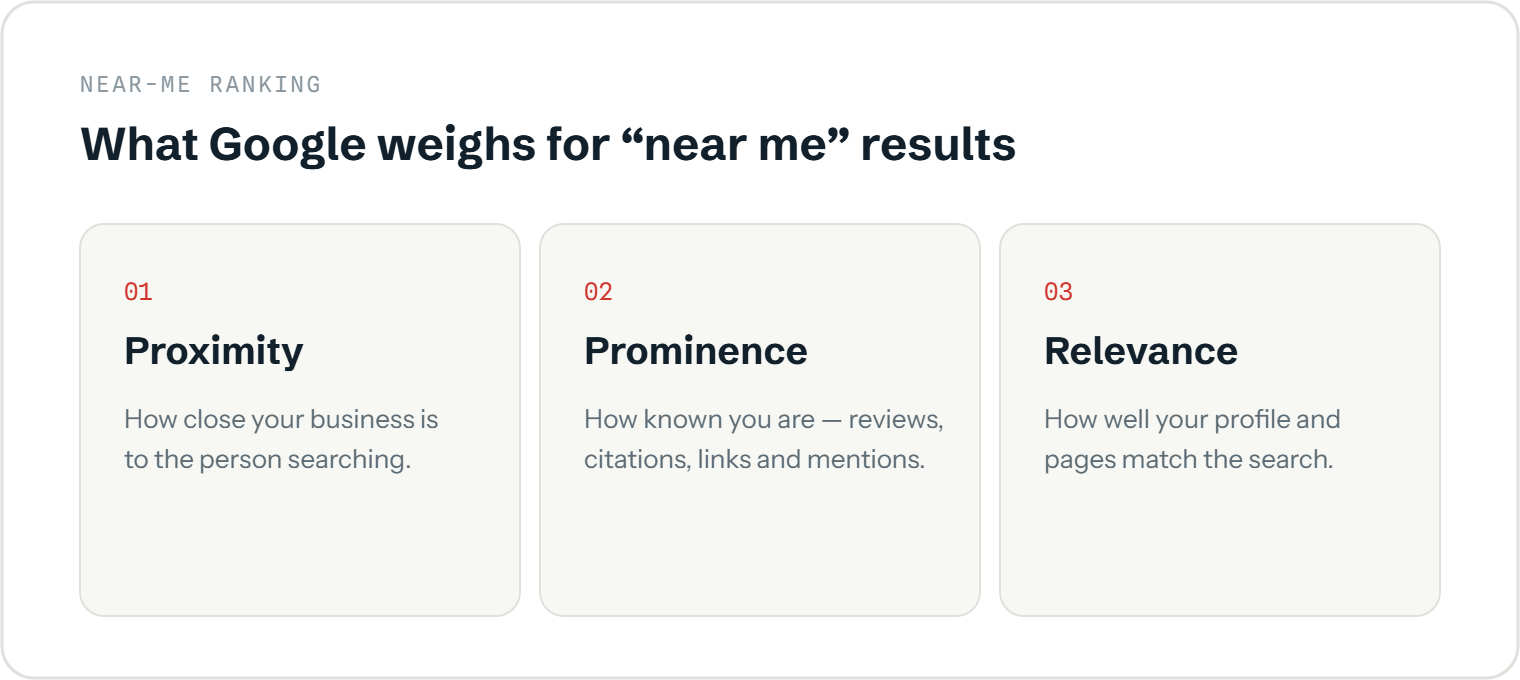
Google's local ranking rests on three public factors:
Proximity. How near your registered business address or service area is to the searcher. This is often the single biggest factor, and it is the one you cannot change. A searcher in Cwmbran will tend to see Cwmbran businesses first, whatever your website looks like.
Prominence. How well known and established your business appears: review count and rating, how complete and active your Google Business Profile is, mentions and links across the web, and general brand authority. This is where sustained effort compounds.
Relevance. How well your business matches what was searched, judged from your profile categories, services, and the content on your website. This is the part on-page SEO and content directly control.
| Factor | Mainly decided by | Can content change it? |
|---|---|---|
| Proximity | Your address / service-area radius vs the searcher | No |
| Prominence | Reviews, profile completeness, citations, links | Indirectly |
| Relevance | Profile categories, service pages, location pages, schema | Yes |
How do you appear at the top of “near me” searches?
Work through the things you can influence, roughly in order of impact:
Claim and complete your Google Business Profile. Correct name, address and phone number, the right primary category, every relevant secondary category, opening hours, service list and a genuine description. An incomplete profile is the most common reason a capable local business never appears.
Earn reviews steadily. A slow, consistent trickle of real reviews with the occasional written reply does more for prominence than almost anything on your website. Volume and recency both matter.
Keep your details identical everywhere. Your name, address and phone number should match to the character across your site, your Google profile, Bing, and directories like Yell or Checkatrade. Inconsistent details make Google less confident it is showing the right entity.
Give each service and place its own real page. One strong page per core service, and one per location you genuinely serve, each written for a person rather than a crawler. Thin, near-duplicate town pages work against you here, which is covered in do I need location pages for SEO?
Add LocalBusiness schema. Structured data stating your name, address, geo-coordinates, area served and hours helps Google tie your website and your profile together as one business.
Where does content genuinely move the needle?
Content works on the relevance factor, and it matters most when proximity and prominence are close between you and a competitor. If two electricians are a similar distance from the searcher with similar review counts, the one whose website clearly covers fuse board replacement in Bridgend, with a proper page, local detail and FAQs, is the more relevant match.
Useful content work for local search looks like: service pages that name the job and the area in the first paragraph; location pages with real specifics about that town rather than a find-and-replace of the last one; an FAQ answering what customers actually ask before they call; and internal links between all of it. This is the core of content-led local SEO, and it also feeds AI answers, which increasingly field “who's a good X near me” questions themselves.
The limit worth knowing about
Content-led SEO has a ceiling for “near me” searches. If a competitor sits physically closer to the searcher, or has 200 reviews to your 15, no amount of on-page work will leapfrog them for that specific search. Proximity can't be optimised, and reviews are earned through service, not markup. A consultant who focuses on content and technical SEO, as I do, can make your site the most relevant option and get the fundamentals right, but the profile management and review-building side is work you or a dedicated local agency needs to own. Anyone promising a guaranteed spot in the map pack is promising something Google doesn't sell.
For businesses in and around Cardiff, Newport and Swansea, the realistic plan is: rank for the service + town terms with genuinely useful pages, keep the Google profile and reviews healthy, and let the “near me” visibility build from there. If you want a clear picture of where your local search stands today, that's what a Webolific audit is for.
If you work in a trade, SEO for tradespeople applies this to plumbers, electricians and builders.
Not showing up for local searches?
A free audit shows exactly where you stand for the “service + town” terms that feed “near me” results — and what to fix first.
Book a free audit