What are topic clusters?.

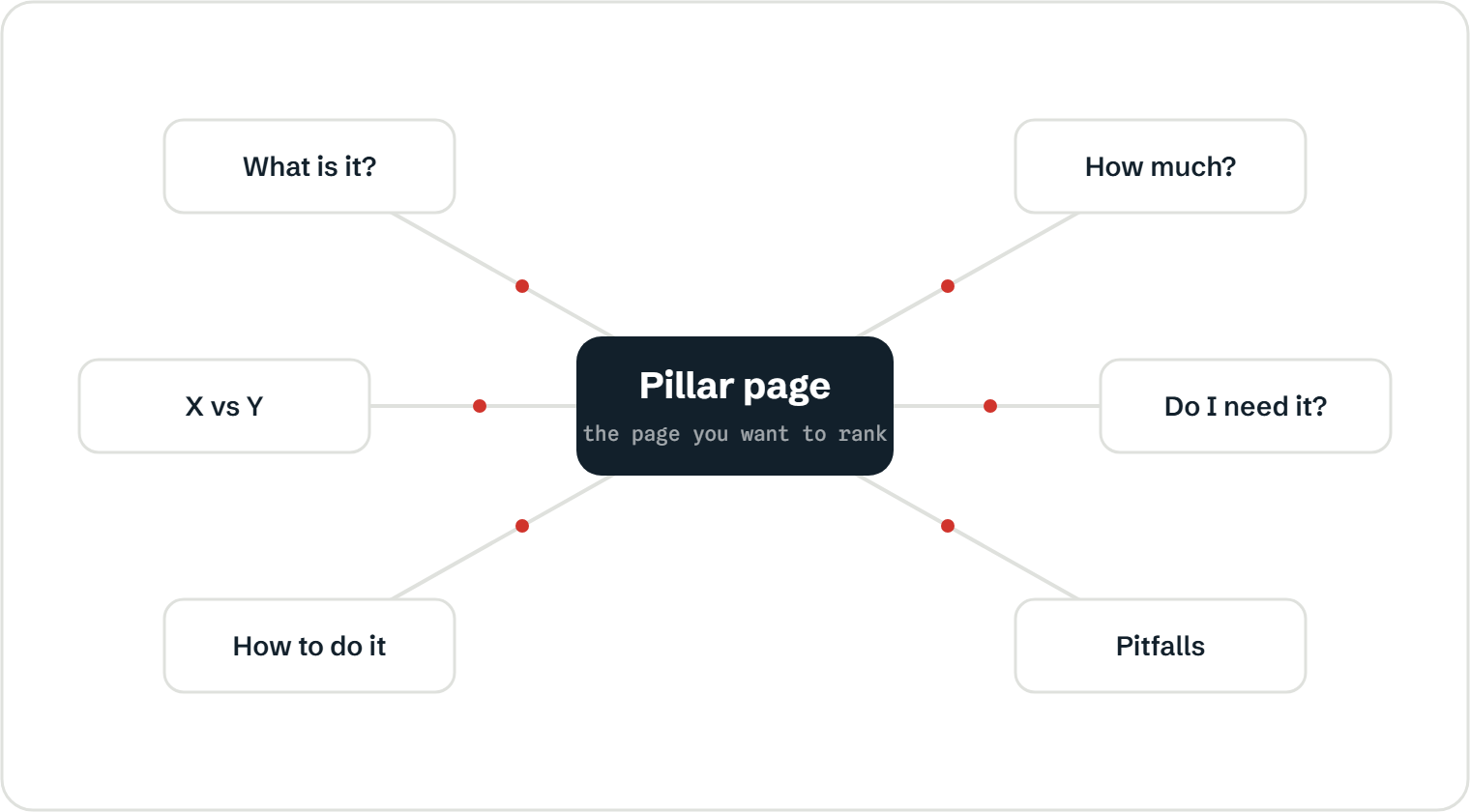
A topic cluster is one broad "pillar" page on a subject, surrounded by a set of focused articles that each answer a single narrower question about it, with every article linking up to the pillar and the pillar linking back down to each one. The pillar targets the competitive head term; the spokes catch the long-tail questions and pass relevance back to the pillar through internal links. It is a way of organising content, not a ranking trick.
What is a topic cluster?
Three parts:
The pillar page. A thorough page on a broad subject, usually a service or category page you want to rank and convert on. For this site, local SEO services is a pillar.
The spokes. Individual articles, each answering one specific question a searcher actually types: how long does SEO take, do I need location pages, how to rank for "near me" searches. Each spoke is genuinely useful on its own.
The links between them. Every spoke links up to its pillar, the pillar links down to its spokes, and spokes link sideways to each other where it helps the reader. That link structure is the part that makes it a "cluster" rather than a pile of blog posts.
Why do topic clusters help SEO?
The benefit is indirect. Google has no "topic cluster" setting it rewards. What the structure actually does:
Internal links move relevance around. When ten focused articles all link to one pillar page using varied, on-topic wording, they tell Google the pillar is the important page on that subject. Internal linking is one of the few ranking inputs you fully control.
Comprehensive coverage makes you the better answer. If your site addresses the head term and twelve of the real questions around it, you are a more complete resource than a competitor with one thin page. That helps in normal search and, per Google's own AI-search guidance, in AI Overviews too, which lean on pages that already rank and answer directly.
It is easier to navigate. Readers, Googlebot and AI crawlers can all move between related pages without guessing. Nothing important sits three unlinked clicks from anything else.
One caution on those internal links: vary the wording and only add a link where a reader would actually want to follow it. A pillar page with forty identical "SEO services Cardiff" links aimed at it from every spoke looks engineered, and Google discounts patterns that look engineered. Write each link the way you would refer to that page in a normal sentence.
What is a pillar page?
A pillar page is the hub: broad, substantial, and aimed at the term with real commercial value and real competition. It summarises the whole subject and hands off the detail to the spokes rather than trying to cover everything at full depth itself. On most business sites the pillar is a money page (a service or product category), because the point of the cluster is to funnel the traffic that lands on the spokes toward the page that converts.
How do you build a topic cluster?
- Pick the pillar: the page you most want to rank and get enquiries from.
- List the questions a buyer asks around that subject. Keyword tools and the "People also ask" box are the quickest source; so is writing down what clients actually ask you.
- Write one spoke per question, phrased as the question itself, each answering it properly rather than teasing it.
- Link every spoke up to the pillar, and sideways to at least one related spoke. Add links from the pillar down to each spoke as it publishes.
- Keep the pillar broad. If a section of it grows long enough to stand alone, lift it out into its own spoke and link to it.
Pace matters less than consistency. One solid spoke a week compounds; ten thin ones published in a burst do not.
What does a real topic cluster look like?
This site is built as three clusters. The guide you are reading is a spoke in the third one.
| Cluster | Pillar page | Example spokes |
|---|---|---|
| Local SEO | /services/local-seo/ | What is local SEO?, Do I need location pages?, Ranking for "near me" searches |
| AI search (GEO) | /services/ai-search-optimisation/ | What is GEO?, What is llms.txt?, GEO vs SEO |
| Choosing SEO help | Homepage + /how-it-works/ | SEO cost in the UK, Freelance vs agency, What is an SEO retainer? |
Do topic clusters still work in 2026?
As a way to organise a site and its internal links, yes. As a shortcut, no, and this is where the idea gets oversold. A pillar-and-spoke structure will not rank a thin pillar page, and it will not manufacture authority a new domain has not earned yet. The clusters on this site are indexed and interlinked; several spokes rank; the pillars are still climbing, because ranking a competitive commercial term also needs links and time that structure alone does not buy. Topic clusters make good content easier for people and machines to find and connect. They do not replace the good content, or the authority underneath it.
The common failure mode is building spokes for their own sake. A cluster of thirty pages, ten of which say almost nothing, is worse than a cluster of eight that each earn their place: the thin pages dilute the subject and can pull the whole section down under Google's helpful-content assessment. Add a spoke when there is a real question to answer, not to reach a number.
If you want a content plan built around your money pages rather than a scatter of blog posts, that is the content and links work, and a free audit maps where the gaps are.
Clusters sit on top of a sound site, so check the basics first: what technical SEO is and how to test your own site for free.
Content plan built around your money pages
A free audit shows which pillar pages you have, which spokes are missing, and where internal links are leaking relevance.
Book a free audit